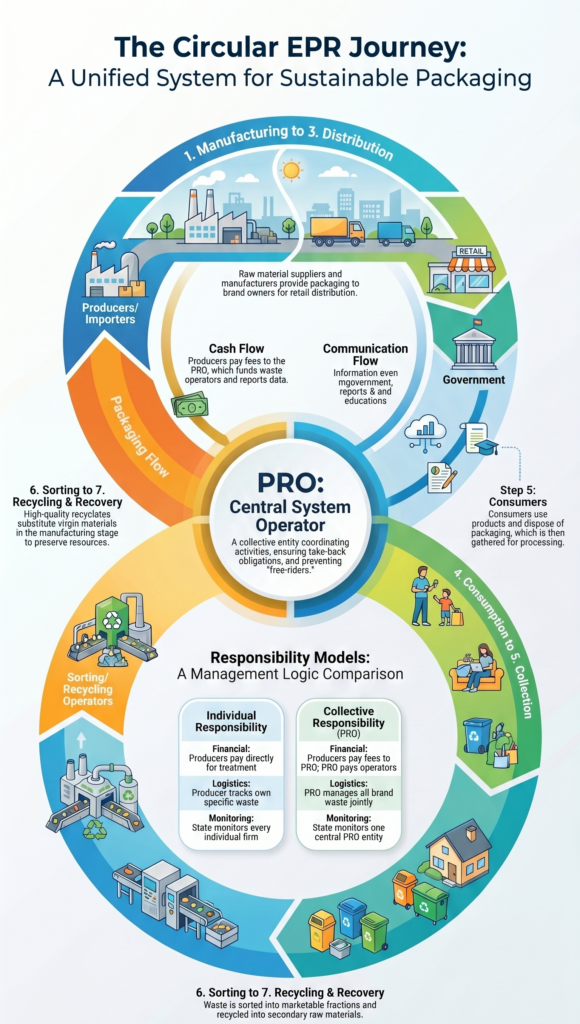
Introduction: The Cost Shock Has Already Started
For many UK manufacturers, the first sign that Extended Producer Responsibility (EPR) was real came in October 2025-when the first disposal fee invoices landed.
Those invoices, based on 2024 packaging data, were higher than expected for many businesses.
But that was only the beginning.
From 2026, EPR moves into a new phase:
eco-modulated fees under the Recyclability Assessment Methodology (RAM).
This is not a marginal adjustment. It is a structural change.
The difference between Green, Amber, and Red packaging bands is not academic-it directly determines how much you pay per tonne.
Manufacturers that do nothing will default into higher-cost bands.
Those that actively assess and optimise their packaging will materially reduce their cost base.
What Eco-Modulation Actually Means for Your Cost Base
Under the UK’s EPR framework, packaging is no longer treated equally.
From 2026, fees are modulated based on recyclability, using the RAM classification:
Green
- Widely recyclable
- Clear collection and processing infrastructure
- Lowest £/tonne fees
Amber
- Recyclable but with limitations
- Inconsistent collection or processing
- Mid-range fees
Red
- Difficult or impossible to recycle
- No established infrastructure
- Highest fees
Why This Matters
This creates a direct financial incentive:
- Two manufacturers selling similar products can face materially different costs
- The difference is driven not by volume-but by packaging design decisions
This effectively turns packaging into a cost lever within your bill of materials (BOM).
What Is Recyclability Assessment Methodology

How the RAM Assessment Works
The Recyclability Assessment Methodology (RAM) is the system used under the UK’s Extended Producer Responsibility (EPR) regulations to determine how recyclable a piece of packaging is-and how much a producer will pay in fees. From 2026, packaging is classified into three bands-Green, Amber, or Red-based on factors such as material type, design, recyclability in UK infrastructure, and labelling.
This classification directly affects cost: packaging that is widely recyclable falls into the Green band and attracts lower fees, while difficult-to-recycle formats fall into the Red band and incur significantly higher charges. As a result, RAM effectively turns packaging design into a financial decision, not just an environmental one.
The Recyclability Assessment Methodology evaluates packaging based on several factors.
1. Material Type
- Is the material widely recyclable?
- Does it have established UK processing infrastructure?
2. Format and Design
- Multi-material packaging is penalised
- Complex structures reduce recyclability
3. Labelling
- Clear recycling instructions improve classification
- Missing or incorrect labels increase risk
4. Evidence and Documentation
- Claims must be supported
- Lack of evidence can push packaging into a worse band
Key Insight
RAM is not just about what your packaging is-it’s about what you can prove it is.
The Data Gap Most Manufacturers Haven’t Fixed
EPR compliance is built on data-and most manufacturers have a gap.
The Problem
Your 2024 packaging submission is now your baseline.
If that data was:
- Incomplete
- Estimated
- Poorly categorised
…then your cost exposure is already misaligned.
Where Data Fails
- Missing SKU-level packaging breakdown
- No material weight accuracy
- Inconsistent supplier information
- Lack of version control
The Risk
Bad data leads to:
- Incorrect RAM classification
- Overpayment of fees
- Audit exposure
Five Packaging Decisions That Move You from Red to Green
The good news: banding is not fixed.
Small, targeted changes can significantly reduce cost exposure.
1. Simplify Material Composition
Move from multi-layer to mono-material packaging where possible.
Impact: Improves recyclability classification immediately.
2. Remove Problem Components
Eliminate elements like:
- Non-recyclable films
- Mixed-material adhesives
Impact: Reduces risk of falling into Red band.
3. Improve Labelling
Add clear, compliant recycling instructions.
Impact: Low-cost change with measurable classification benefit.
4. Validate Recyclability Claims
Ensure all claims are backed by:
- UK-specific infrastructure evidence
- Accepted standards
Impact: Prevents downgrade due to lack of proof.
5. Rationalise SKU Variants
Reduce unnecessary packaging variation across product lines.
Impact: Simplifies compliance and improves consistency.
Reality Check
Not every change is cost-neutral.
But the right approach is not “reduce cost at all costs”-it’s:
Optimise total cost = packaging cost + EPR fee exposure
What to Do This Quarter: Your EPR Action Plan
For manufacturers managing multiple SKUs, the challenge is prioritisation.
Step 1: Identify High-Risk Packaging
- Focus on high-volume SKUs
- Flag likely Red/Amber classifications
Step 2: Run a RAM Pre-Assessment
- Score packaging against key criteria
- Identify quick wins vs structural changes
Step 3: Quantify Cost Impact
- Estimate £/tonne differences between bands
- Model financial exposure
Step 4: Prioritise Interventions
- Low-cost, high-impact changes first
- Longer-term redesign where justified
Step 5: Document Everything
- Record decisions
- Maintain evidence
- Prepare for audit
How EPR Compliance Impacts Commercial Risk
EPR is no longer just a regulatory issue-it is becoming a procurement signal.
Where It Shows Up
- Supplier questionnaires
- ESG disclosures
- Tender evaluations
The Direction of Travel
Buyers are increasingly asking:
- Is your packaging compliant?
- What is your recyclability profile?
- How are you reducing environmental impact?
The Risk
Non-compliance-or poor documentation can:
- Delay onboarding
- Reduce competitiveness
- Exclude you from preferred supplier lists
From Reactive Compliance to Structured Control
Most manufacturers today are managing EPR through:
- Spreadsheets
- Email chains
- Ad hoc documentation
This does not scale under RAM.
What a Structured Approach Looks Like
SustainGate
- Centralises EPR documentation
- Stores RAM assessments and submissions
- Maintains an audit-ready evidence trail
SustainZone (Optional Layer)
- Supports Scope 3 packaging emissions tracking
- Aligns with broader sustainability goals (e.g. SBTi)
Together, they move EPR from:
reactive reporting to controlled, auditable workflow
Conclusion: Packaging Is Now a Cost Decision
EPR has changed the role of packaging in manufacturing.
It is no longer just:
- A design decision
- A logistics consideration
It is now a direct cost driver.
The manufacturers that act early will:
- Reduce fee exposure
- Improve compliance position
- Strengthen their commercial standing
Those that don’t will simply pay more.