Airports and aerodromes cannot wait for sustainable aviation fuel, hydrogen or electric aircraft to scale. Learn why Scope 3 emissions, supplier engagement and better carbon data are critical for aviation decarbonisation.
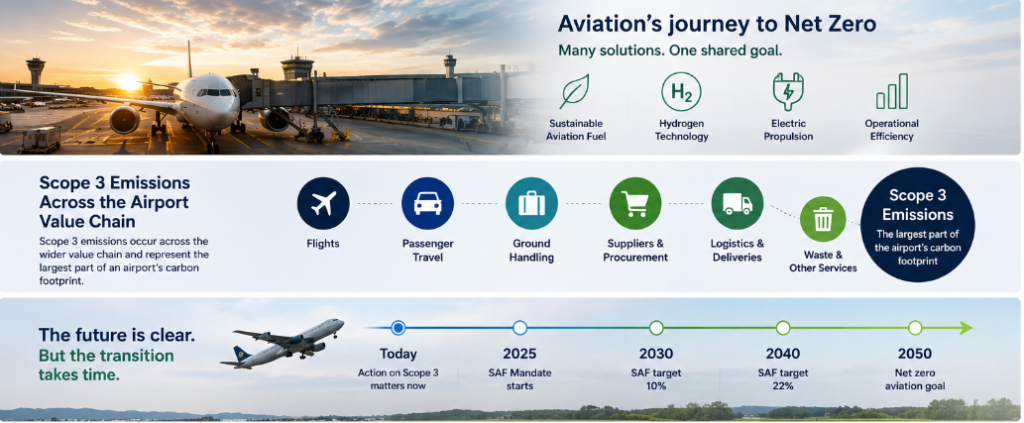
The aviation sector is under growing pressure to reduce carbon emissions. Governments, airports, airlines, investors and local communities all recognise that aviation must move towards a lower carbon future. Long term solutions such as sustainable aviation fuel, hydrogen aircraft, electric propulsion and next generation aircraft technology will all have an important role to play.
However, these solutions will take time to scale.
That creates an important question for airports and aerodromes: what can be done now?
The answer is Scope 3 emissions.
What are Scope 3 emissions for airports?
Scope 3 emissions are the indirect emissions that occur across an airport’s wider value chain. For airports and aerodromes, this can include emissions from flights, passenger travel to and from the airport, staff commuting, ground handling, suppliers, procurement, waste, logistics, construction activity and other partner operations.
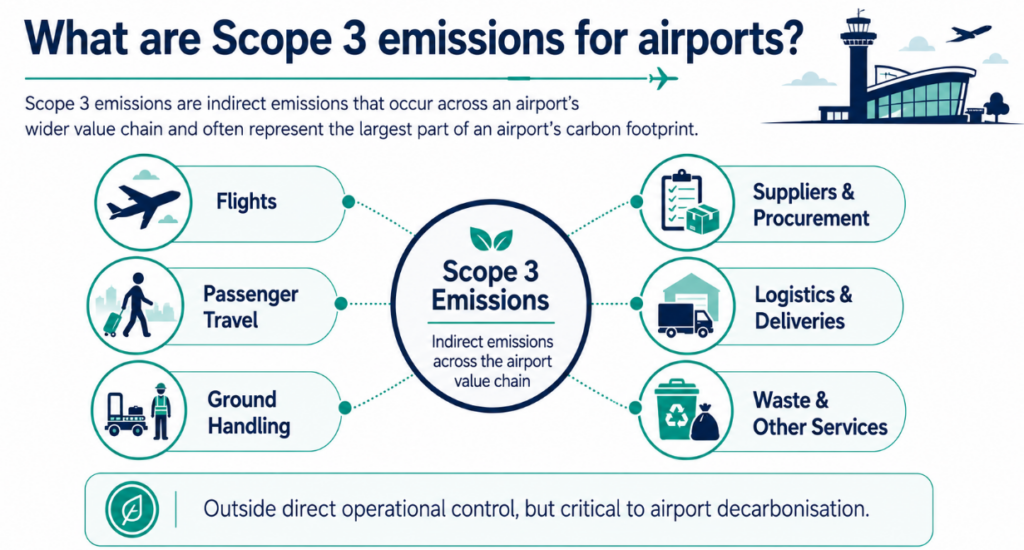
These emissions are often outside the airport’s direct operational control. However, they can represent the largest part of an airport’s carbon footprint.
This is why airport Scope 3 emissions should not be treated as a secondary reporting exercise. They should be treated as a core part of aviation decarbonisation strategy.
Why alternative fuels are not enough in the short term
Sustainable aviation fuel, commonly known as SAF, is one of the most important tools for reducing aviation emissions. The UK SAF Mandate is helping to create a clearer route for SAF adoption, but availability, production capacity, cost and supply chain readiness remain major challenges.
Hydrogen and electric aircraft also have long term potential, particularly for certain routes and aircraft types. However, they require new infrastructure, safety planning, certification, operational changes and significant investment before they can be widely used across commercial aviation.
This means that airports cannot rely only on future fuels or future aircraft technologies. Long term net zero aviation targets are important, but they do not remove the need for practical action today.
Why Scope 3 action matters now
While alternative fuels and future aircraft technologies continue to develop, airports still have an immediate opportunity to reduce emissions across the activities they influence today.
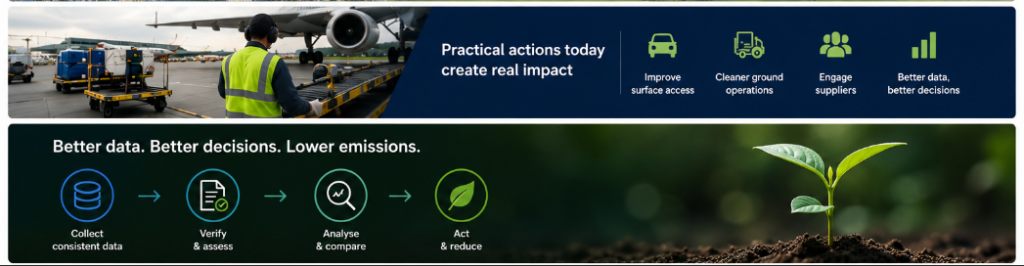
This includes working with airlines, ground handlers, transport providers, suppliers, tenants, local authorities and logistics partners. Practical action can include improving surface access, reducing inefficient vehicle movements, encouraging cleaner ground support equipment, improving supplier carbon reporting, identifying low carbon procurement opportunities and strengthening data quality across the airport ecosystem.
For many airports, the challenge is not only emissions reduction. It is also visibility.
Scope 3 data is often fragmented. Different suppliers may report information in different formats. Some partners may have strong evidence, while others may provide estimated or incomplete data. This makes it difficult for airports to compare carbon reduction opportunities and decide where investment should be prioritised.
The need for better carbon data and MRV
To make Scope 3 emissions manageable, airports need better measurement, reporting and verification. This is often referred to as MRV.
A strong MRV approach helps airports collect consistent information from suppliers and partners. It also helps identify which data is reliable, which assumptions are being used and which emissions sources need further validation.
This matters because carbon reduction decisions should not be based on broad estimates alone. Airports need to understand which actions are measurable, feasible and supported by evidence.
For example, if an airport is considering investment in cleaner ground operations, improved surface access or supplier decarbonisation, it needs to compare the expected carbon impact, cost, delivery risk, data quality and implementation timeline. Without consistent Scope 3 data, these decisions become harder to justify.
Why this is important for regional airports and aerodromes
Large international airports often have more resources, larger sustainability teams and wider access to specialist data systems. Regional airports and smaller aerodromes may face the same net zero expectations, but with smaller teams and tighter budgets.
This makes a practical Scope 3 approach even more important.
Regional airports and aerodromes need methods that are simple enough to use, but robust enough to support funding applications, board level decisions, supplier engagement and sustainability reporting. They need to understand where emissions are coming from, which partners are involved and which actions can deliver measurable progress.
Scope 3 carbon management can also support wider airport priorities, including operational resilience, local community confidence, investment planning, procurement decisions and future readiness for low carbon aviation technologies.
Moving from reporting to decision making
The next stage of airport decarbonisation is not just about producing carbon reports. It is about using carbon data to make better decisions.
A good Scope 3 strategy should help airports answer practical questions.
Which emissions sources are most significant?
Which suppliers and partners hold the most important data?
Which reduction actions are already underway?
Which opportunities need more evidence?
Which interventions are realistic in the short term?
Which options should be prioritised for future investment?
This is where airports can move from carbon accounting to carbon decision making.
Conclusion
Alternative fuels, hydrogen, electric aircraft and new aviation technologies will be important for the long term transition to net zero. However, airports and aerodromes cannot wait for these solutions to scale before taking action.
Scope 3 emissions are where much of the immediate opportunity sits.
By improving supplier engagement, strengthening MRV, collecting better carbon data and comparing reduction options more effectively, airports can make practical progress today while preparing for the aviation technologies of tomorrow.
The future of airport decarbonisation will not depend on one solution alone. It will require cleaner fuels, better infrastructure, stronger supply chain collaboration and more intelligent use of carbon data.
For airports and aerodromes, the message is clear: Scope 3 action is not a future task. It is a present priority.